This is a short clip from a previous live Power of the Points training session. Learn more about the Power of the Points course here.
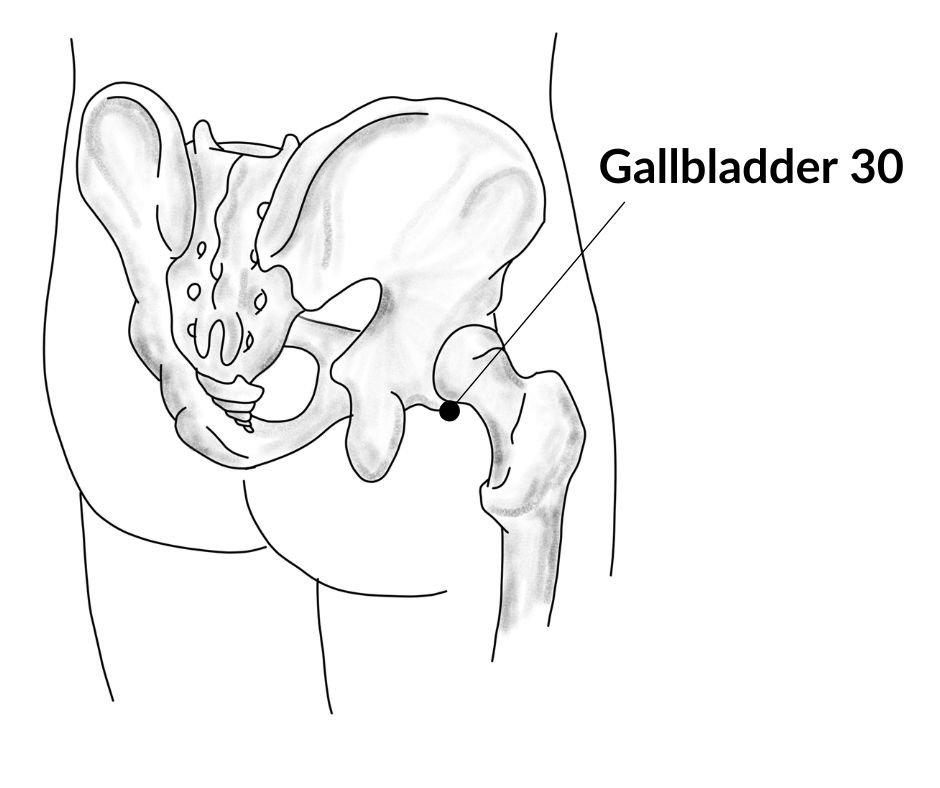
Deep in the gluteal region sits a powerful point. GB 30 is a gateway for relieving pain radiating from the glute muscles down the leg. I often use this point with patients in my medical practice to relieve sciatic nerve pain, general buttock and hip tension and lower back discomfort. Watch the video to learn one way to work with it in your yoga practice!
Looking for a yoga or movement class for your hips? Try this somatic movement class to support your hips.
Along with the physical indications I mentioned, you can also use this point if you’re feeling mentally or psychologically stuck, tense or stressed. Learn more about how the Gallbladder and Liver (the Gallbladder’s paired organ) relate to mental health here: Healing the Liver for Emotional Harmony: TCM Insights & Remedies and here: From Frustration to Flow: TCM Acupressure for Liver Qi.
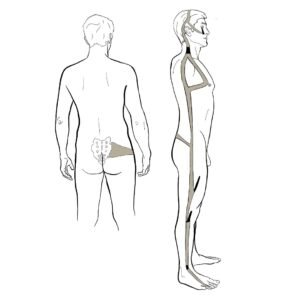
Gallbladder 30 (GB 30) is on the Gallbladder meridian, which traces a long, winding route from the outer corner of the eye, zigzagging over the head, down the side of the neck and torso, across the hip, and along the outer leg to the fourth toe. It is also a meeting point of the Bladder channel, making it effective for lower back pain (where the Bladder meridian runs).
 This point lies at the junction of the upper and middle thirds of a line connecting the sacral hiatus (the base of the sacrum) to the greater trochanter (the bony prominence at the top of the thigh). In practice, it sits in the middle of the buttocks.
In classical Chinese medicine, GB30 is called Huantiao, meaning “jumping circle” or “circular leap”. The name captures what happens when the point is stimulated: a patient who had been hobbling might, in time, leap again. It speaks to the restoration of mobility and the recovery of easy and healthy walking.
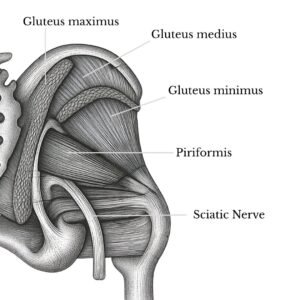
Anatomically, the point lies over the piriformis and the sciatic nerve. Stimulation near this point can produce a distinct sensation! Many patients describe it as an intense “good pain”; it’s uncomfortable yet clearly reaches deep. From a traditional perspective, it frees the flow of Qi and Blood through the Gallbladder meridian and treats “wind cold and damp”, removing obstruction that causes pain and immobility. From a biomedical perspective, it stimulates nerves, muscles, and connective tissue, producing measurable neurological and biochemical responses.
 Sciatica — Pain, numbness, or tingling radiating from the lower back or buttocks into the leg along the sciatic nerve’s path.
Hip pain — Arthritis, bursitis, and general hip joint pain, especially when movement is restricted or aching.
Lower back pain — Particularly pain in the sacral and gluteal region, often used alongside other lumbar points.
Piriformis syndrome — Tightness or spasm in the piriformis muscle, which lies directly beneath the point, causing sciatic-like symptoms.
Leg weakness or tension — Atrophy, flaccidity, tension or weakness in the lower limb.