Myofascial Sheaths
The myofascial lines, planes, or sheaths provide a helpful map for understanding how positive and negative stress patterns are relayed and transferred through the body’s structures. Follow along for an exploration of the planes of the body by signing up for the series here.
The Ventral Plane
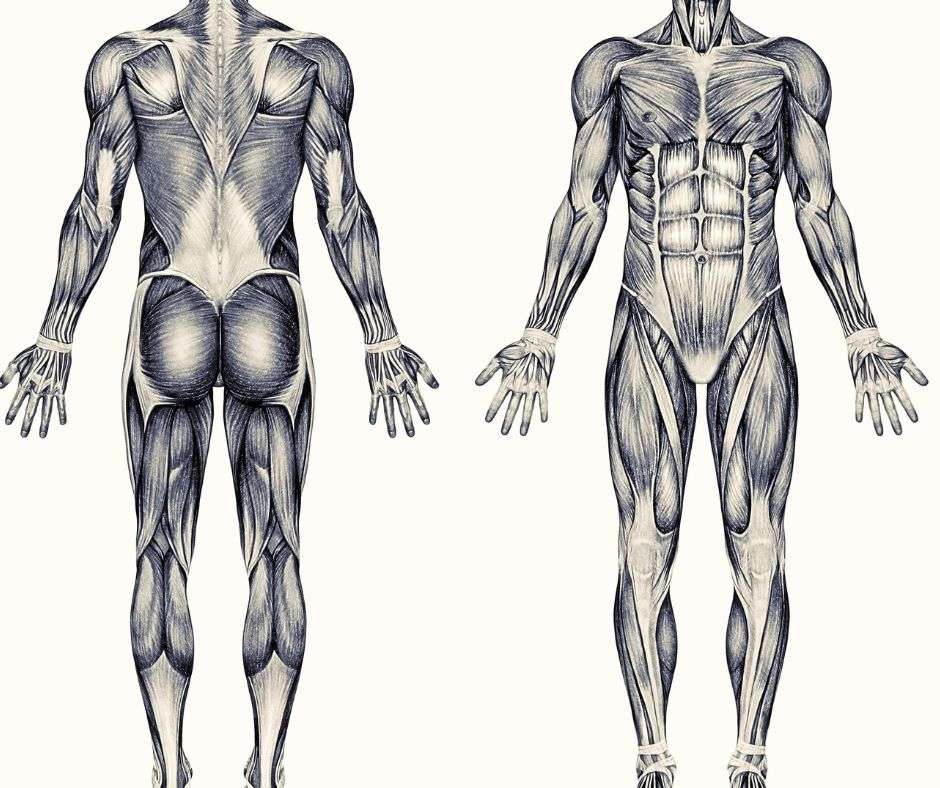
The ventral plane of the body is similar to what Thomas Myers refers to as the “superficial front line.” When standing, the body’s front line functions as a continuous sheath of tissue. Overall, the front plane helps to balance the back (dorsal) line in the body. It’s also responsible for the ‘lifting’ of specific bony structures, such as the pubic bone and the rib cage. The ventral plane also helps protect the torso’s organs that would otherwise be exposed and vulnerable.
The ventral sheath starts at the top of the feet and travels up the front of the legs (tibialis anterior and quadriceps) to the pubic bone. It then travels up the front of the torso (rectus abdominus) to the sides of the neck (sternocleidomastoid).
Self Protection and the Front Body
A common postural indication of imbalance between the front and back planes is a person whose front body seems to sag or draw in, while the back body lifts. This posture resembles a person who feels threatened (similar to the startle response). From this perspective, a yoga practitioner can understand the relationship between a tight or shortened abdominal area and how this possibly indicates self-protection and/or a lack of true personal power, which classically resides in the belly center (3rd chakra).
"SRADDHA VIRYA SMRTI SAMADHI PRAJNAPURVAKA ITARESAM"
A space of nourishment for growth is preceded by trust, strength, mindfulness, focus and refined knowledge.Yoga Sutra 1.20
While experiencing the poses below, reflect on your relationship to sraddha (trust). Connect with your innate intelligence, which knows you are capable. Rest in the knowledge that you are safe in this moment and that your divine nature helps guide every moment of your life.
Movement to Open the Ventral Plane
Before you begin, lie on your back and focus on your body. Notice if you are holding yourself off the ground. Bring your attention to your lower abdomen, the center of your chest, and the top of your chest. Observe any gripping or tensing and notice any feelings or tightness. Sense whether your shoulders seem to fall forward towards your chest (lift off the floor). As you settle, breathe deeper into the body and consciously relax your belly, chest, and shoulders.
Backbends help to open and lengthen the ventral plane. Start with smaller backbends and add twisting poses before deeper backbends. This will encourage the horizontal bands of tissue (abdominal obliques) and the vertical bands (rectus abdominis) to mobilize and slide more easily against one another. Use the poses below to open and feel the ventral sheathing for yourself:
Vajrasana (broken toe) – Kneel on the floor, tuck your toes, and sit back on your heels. Work on having all ten toes tucked, and don’t let your heels fall out to the side. If sitting back is too painful, place a block on your heels to sit on or place your hands on a chair in front of you to reduce the pressure. Use this pose to open the front of the foot (retinaculum and extensors).
Danurasana (bow) with bolster – Place a bolster horizontally across your mat. Lie on the bolster (place the bolster under your lower ribs and upper belly). Place your elbows and forearms on the bolster. Bring your feet and knees close together. Bend your knees and grab your flexed feet with your hands. Roll your shoulder blades back and in. Kick with your feet into your hands to lengthen the front of your body. In this variation, your hips, thighs, and knees can stay on the floor. Focus on drawing the coccyx (tailbone) in and lifting the sternum.
Supta Virasana (reclined heroes) – Sit between your feet with the sitting bones firmly rooted. Use a block or another support under you if your sitting bones don’t contact the floor. Place your feet beside your outer hips with your toes pointing directly back. From this position, lean back and support your spine on a bolster or lie directly on the floor. Lengthen your sacrum away from your lumbar, and don’t allow the knees to splay out to the sides. As much as possible, track the thigh bone (femur) in a straight line with the hip.
Salamba Setu Bandhasana (supported bridge pose) – Place a bolster lengthwise on your mat and a block at the end of the bolster. Loop a yoga strap around your thighs. Make sure the loop is tight enough to keep your legs together. Support your sacrum and legs with the bolster and place your feet on the block. Lay your shoulders and head off the bolster on the floor. If you experience lower back pain in this pose, use more height under your feet or bend your knees. Soften across your belly and throat.
I hope that helps to open your ventral plane 🙂 Thank you so much for reading!
Join me in exploring the body’s planes by signing up for my mailing list.