Myofascial Sheaths
When studying and discussing the human body, we often treat individual anatomical parts as separate from the rest. This, of course, is not true; everything in the body is deeply interconnected.
One way anatomical structures connect to (and are affected by) one another is through the fascia, which wraps and weaves around all structures. The fascia is light and airy in some areas of the body and tough and dense in others. Its purpose is manifold, but keeping it pliable and adaptable is crucial.
The myofascial meridians, lines or sheaths that connect seemingly unrelated areas of the body, are particularly interesting to the yoga practitioner. By looking at the body through the lens of these sheaths of tissue or what Thomas Myers terms “myofascial meridians,” one can more deeply grasp how patterns of strain and pain, as well as freedom and movement, transmit through the body’s physical structure.
The Lateral Plane
The lateral plane of the body is a good starting point for exploration because it is considered one of the outermost sheaths. This sheath is like a container for the body, helping to balance and coordinate movements between the front and back and adjust for differences between the left and right sides.
The lateral plane begins at the base of the 1st and 5th toes. From there, it travels to the outside of the foot and along the lateral (outside) of the body, including the side of the leg, torso and neck.
From this perspective, a yoga practitioner can understand the relationship between the outer ankle bone and the greater trochanter of the leg (outer hip). For example, during a standing posture, pressing the outer heel towards the floor will create a ripple of sensation and activation up the sheathing of the outer leg, potentially affecting the outer hip.
Annamaya Kosha // Gall Bladder Meridian
In Ayurveda, the ancient Indian system of medicine, the body’s outermost layer is named the annamaya kosha (food body). This outermost kosha (sheath) is the coarsest (sthula) of all the sheathings. Because it’s considered the most physically dense aspect of our being, we can understand it as related to the lateral plane and our need to free trapped tension in the tissue.
The lateral plane is also correlated with the Gallbladder channel of Traditional Chinese Medicine. The Gallbladder channel, which houses and transmits Qi, travels along the side of the body, much like the sheathing of the lateral plane. According to Chinese Medicine, the Gallbladder can become “stressed” quite easily, and this often translates into tension along the channel, such as tight outer hips (iliotibial or IT band), tight buttocks (gluteus muscles), and/or a tight neck (trapezius, levator scapula, and sternocleidomastoid).
Shamata Meditation :: The Foundation
Use meditation practices that ground your energy in the body to support opening the lateral plane, annamaya kosha, and the Gallbladder channel. In particular, shamata (calm abiding) helps center attention on a single point. The technique is soothing and can settle a stressed mind. It comes from the root word “-sham,” which means “to pacify. “
By settling the mind on a single place of residence, such as watching the breath come and go (anapanasati), a type of shamata practice, you create what Ajahn Chah called “a ground of listening.” This deep listening stabilizes the nervous system and invites what Buddhist teacher Kittisaro calls the “metabolizing of dukkha” (discomfort). This “metabolizing,” or processing of tension held in the mind, will support the lateral sheath in opening and releasing physical patterns of strain.
Movement to Open the Lateral Plane
In most bodies, the lateral plane is tight while the inner planes of fascia, such as the core muscles and inner spiral, are weak. For example, the vastus lateralis (outer front thigh or quad) tends to be strong in most people (especially in athletic bodies), but the inner legs (primarily the adductors) remain weak. Because this outer quad shares a compartment with the lateral hamstring (which lies more on the back of the thigh), the legs are pulled out into external rotation more than is appropriate, leading to issues such as sciatica.
Based on the above example, assess which side of your body feels more tightly held. When lying flat on your back, how do your legs fall to the side of your mat?
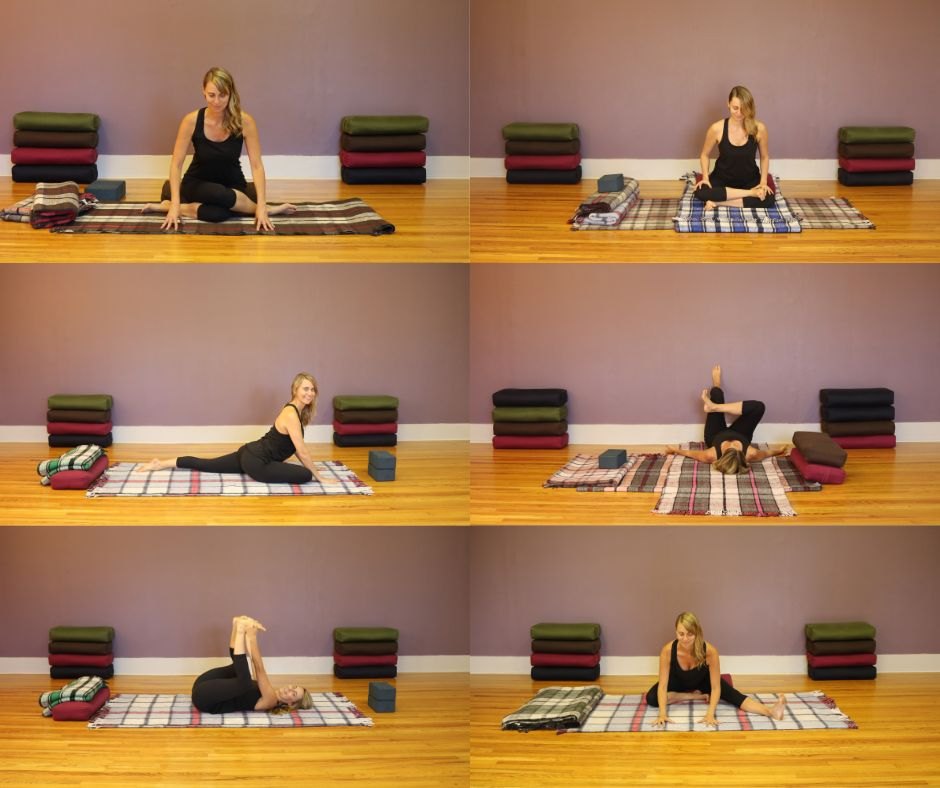
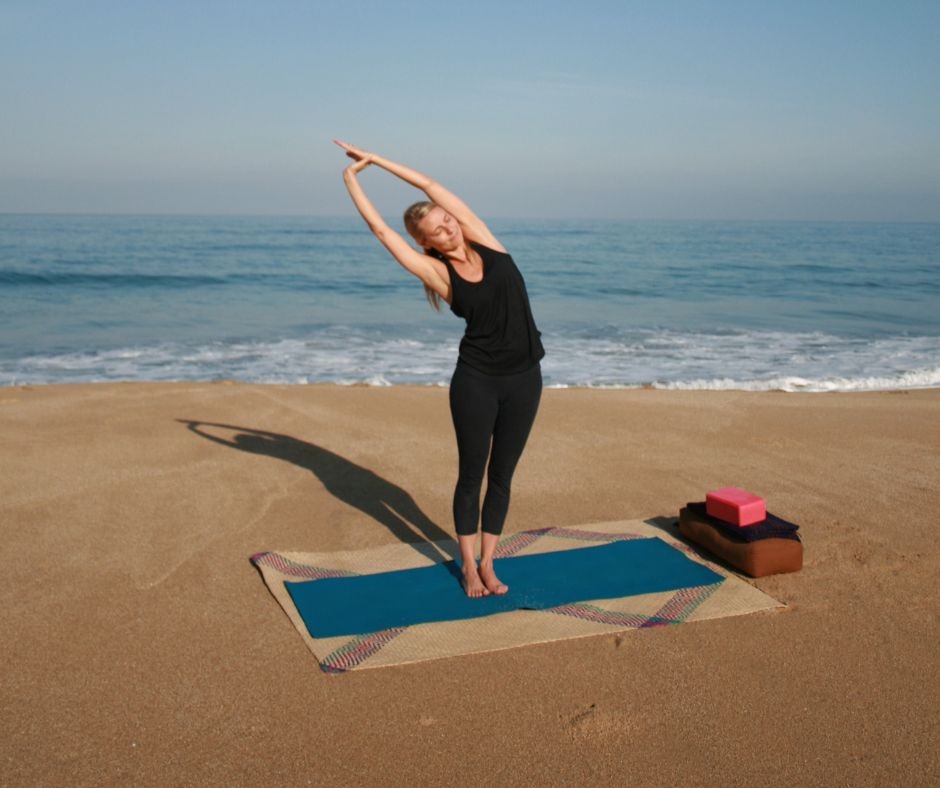
Side-bending poses, some “hip openers,” and poses that stretch the outside of the leg help to open the lateral sheath. Use the poses below to open and feel the lateral sheathing for yourself:
- Sukhasana (easy pose), seated or lying – similar to a cross-legged position, except the feet are pulled further away from the pelvis. In the seated variation, you can fold forward while maintaining lift out of the pelvis. In a lying position, grab the outside of your feet and draw them towards your face and down towards your body. You can also use straps if you can’t reach the feet.
- Parighasana (gate) – Sit upright, kneeling with your hips directly over your knees. Extend one leg so that it’s beside you in a direct line with the opposite knee. Engage the quad of the extended leg as you side bend towards the extended leg. Reach with your upper arm towards your foot as you roll your belly away from the extended leg.
- Wide-legged Adho Mukha Svanasana (downward dog) with heels out and toes in – Step back into your downward dog. Bring your toes in and your heels slightly out. Press your outer heels to the floor as you lengthen the side waist away from the ilia (hip bones). Lengthen your outer arm by reaching your pinkie finger longer.
- Virabhadrasana II (warrior 2): Back foot against the wall – step your feet wide and place your back foot parallel to, and press against, the wall’s baseboard. Bend your front knee, ground your whole front foot and continue to press into your back foot as you reach your arms out.
- Prasarita Paddotannasana (wide-legged forward fold) with strap – Step your feet wide and bring your toes in and heels slightly out. Place a looped strap under the heels. Press into the outer heel and break away from the strap. As you fold forward, lift your sitting bones and continue to break out against the strap.
I hope that helps to open your lateral plane 🙂 Thanks for reading!
Follow along on an exploration of the planes of the body by signing up for my 5-day series exploring the planes of the body here.