
What are the Five Elements in Chinese Medicine? and How do the Five Elements Work?

blog post what are the 5 elements how do the five elements work jennifer raye

The theory of the five elements is a foundational concept in Traditional Chinese Medicine. The five elements are used to describe cycles, dynamic qualities, and patterns, which in turn inform an understanding of health and disease. The Chinese yogis and physicians observed the natural world to find patterns, and by identifying these patterns, they could explain the body and states of disease.

Read below and watch the video to learn more about the system of five elements and their corresponding energies and seasons.

How do the five elements in Chinese Medicine work?

Through observing the natural world, the theory of the five elements was created. The five elements are the five phases of a cycle, and each element describes a point at which energy changes.

All elements are connected. There are many relationships between the elements. Some elements nourish each other, while others control each other. Water is the most yin, for example. It’s slow, dark, and cold. Fire is the most yang. It’s fast, fiery, and bright. The elements help generate one another, control one another, and even attack each other when there’s pathology. Each element also has a related colour, sound, smell, emotion, internal organs, and meridians.

How to use the five elements of Chinese Medicine:

You can use knowledge of five-element patterns and energies to determine where you’re out of balance. You can also use them to attune to the natural cycles that occur regularly.

You can see these cycles and better understand them by looking at the movement of the seasons. Learn about the seasons and how they relate to the five elements in my articles on the Seasonal Points (Solar Terms): Winter, Spring, Summer, and Fall.

What are the five elements?

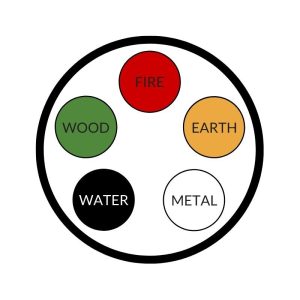
The elements are usually represented visually in a circle, with each preceding the last.

Let’s start with the water element. The water element is a time of rest before growth. Its movement is downward. It’s when energy is stored, just like plants storing energy in their roots during the winter. This element relates to the Kidneys and Bladder in Chinese Medicine and to deep potency and stamina.

After the water element comes the wood element. The wood element is a time for growth and expansion. It’s related to springtime, birth, and new beginnings. This element is related to the Liver and Gallbladder, direction, creativity, and vision.

Then comes fire and the season of summer. The fire element is a time of upward movement and maximum function. It’s associated with growth and expansion. This element is related to the Heart, Small Intestine, Pericardium, and the San Jiao. The San Jiao is not an organ in Western anatomy, but it’s still important in the Chinese Medicine view of the body.

Next comes the earth element and the late-summer season. Earth is neutral and represents balance. The earth element is stable and related to nourishment. It’s related to the Spleen and Stomach and to the digestion of food, thought, and experience.

Next comes fall, the metal element and a state of decline. Metal is a time of harvest and a contraction of energy. Metal is related to the Lungs and Large intestine and concerns taking in inspiration and letting go of what no longer serves us.

The theory of the five elements forms a very holistic view of the body and the natural world. There is so much more to this beautiful system, so make sure to keep learning! Thank you for watching and reading, and I’ll see you again very soon.
Chinese Medicine for Yoga Online Training

Chinese Medicine Food Therapy Online Course

Share This Post:

More To Explore

blog post release the dorsal plane jennifer raye

Myofascial Meridians: Release the Back Body

Myofascial Planes The myofascial lines, meridians, planes, or sheaths provide a helpful map for understanding how positive and negative stress patterns are ...
Read More →
blog post herbal nutrition for your health jennifer raye

Easy herbal medicine to get more nutrition in your day

There are many health concerns that we can address through greater nourishment. Many natural remedies have such a positive effect on the ...
Read More →
Liver Qi emotions TCM

Healing the Liver for Emotional Harmony: TCM Insights & Remedies

In traditional Chinese medicine (TCM), the Liver is more than just a physical organ; it is the master regulator of Qi (vital ...
Read More →
blog post what is aromatherapy jennifer raye

What is Aromatherapy?

Aromatherapy is the use of the “essential” or “aromatic” oils of a plant for physical, psychological, and aesthetic purposes. Aromatherapy is one method within the ...
Read More →
pericardium triple burner meridians jennifer raye

Pericardium and Triple Burner Meridians for Yoga

In Chinese Medicine, the Pericardium and Triple Burner (San Jiao) are paired. When looking at organs through the lens of Chinese Medicine, it’s important to ...
Read More →
blog post how to use the five flavors of chinese medicine fatigue jennifer raye

Food as Medicine || Using the Five Flavours of Chinese Medicine

“If people pay attention to the five flavours and blend them well, Qi and Xue (Blood) will circulate freely, and breath and bones will be ...
Read More →
Scroll to Top