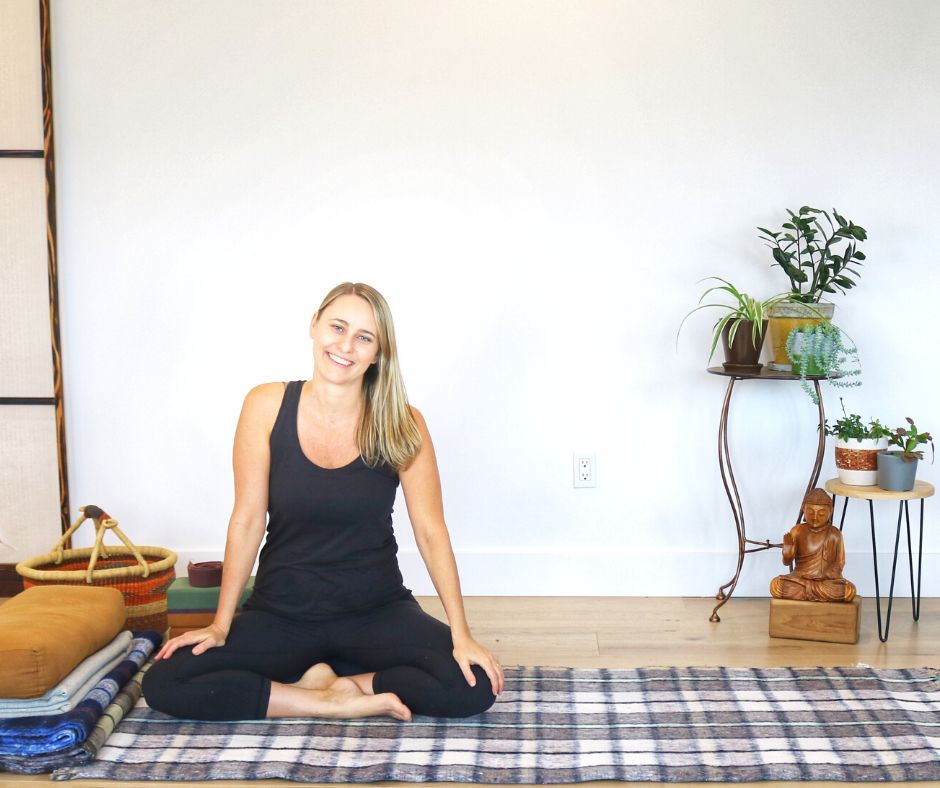
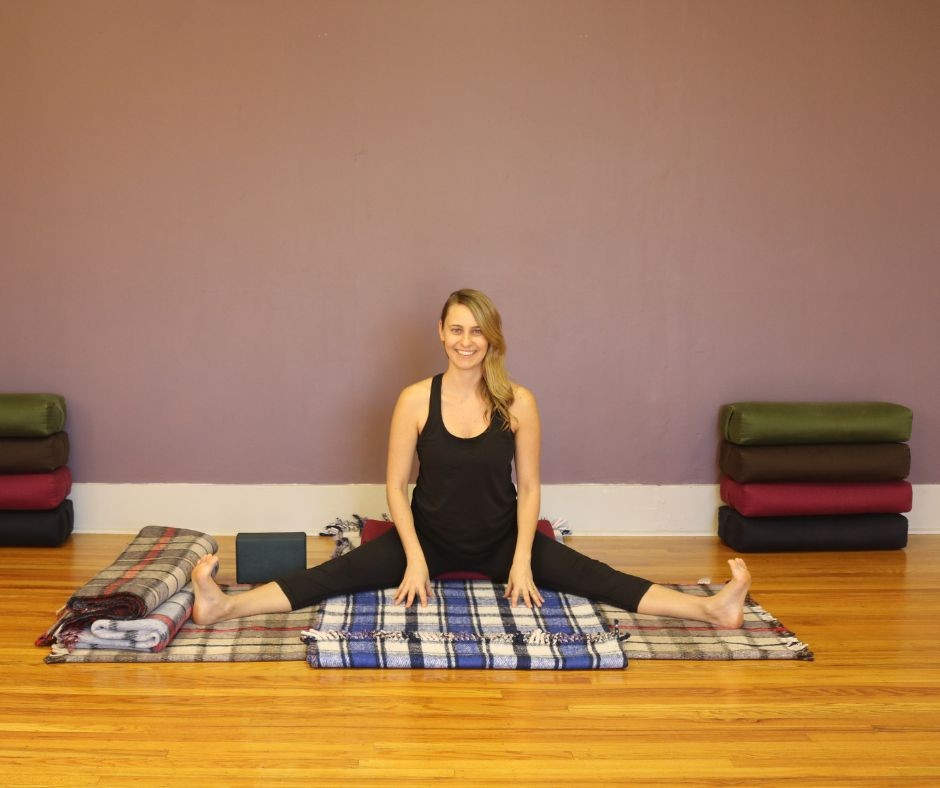
Yin yoga dragonfly posture, or straddle pose, is a forward fold with the legs wide. From a seated position, a forward fold, a side bend or a twist can be practiced.
A yin yoga dragonfly pose targets the backs of the thighs (hamstrings), hips, inner groin, and inner knees. It also activates the Kidney, Urinary Bladder, Liver, and Spleen meridians.
If a yin yoga dragonfly side bend (lateral dragonfly) is practiced, the Lung, Heart, Large Intestine and Gallbladder meridians are activated, and the upper arm, shoulder, chest and abdomen open.
If a yin yoga dragonfly with a twist is practiced, the Spleen, Stomach and Gallbladder meridians are activated, and circulation in the abdomen and internal organs is increased.
Yin Yoga Dragonfly Pose and Straddle Pose Variations
From a seated position, you can place a height under your hips to encourage a forward tilt of the pelvis. If you have a history of sciatica or lower back concerns, this is especially important.
If your hamstrings are tight or this posture puts too much pressure on your knees, you can also support your knees with padding, bend your knees and place your feet on the floor, or engage your quads (the tops of your thighs). Or try butterfly pose.
For the yin yoga dragonfly forward fold, lean forward from the seated position. You can either support your head with your hands or a prop, or let the head and back hang forward. Be sure not to collapse into the diaphragm, and if you have a history of kyphosis (a rounding in the upper back), you may want to keep the spine long and focus on the opening at the back of the legs instead of rounding the spine forward.
For the lateral dragonfly, lean to the side and shift slightly forward on your sitting bones. You can reach your upper arm over your head, and if it’s available, you can grab hold of your foot. Prop your bottom arm on the floor or a bolster and then rest your head on your lower hand.
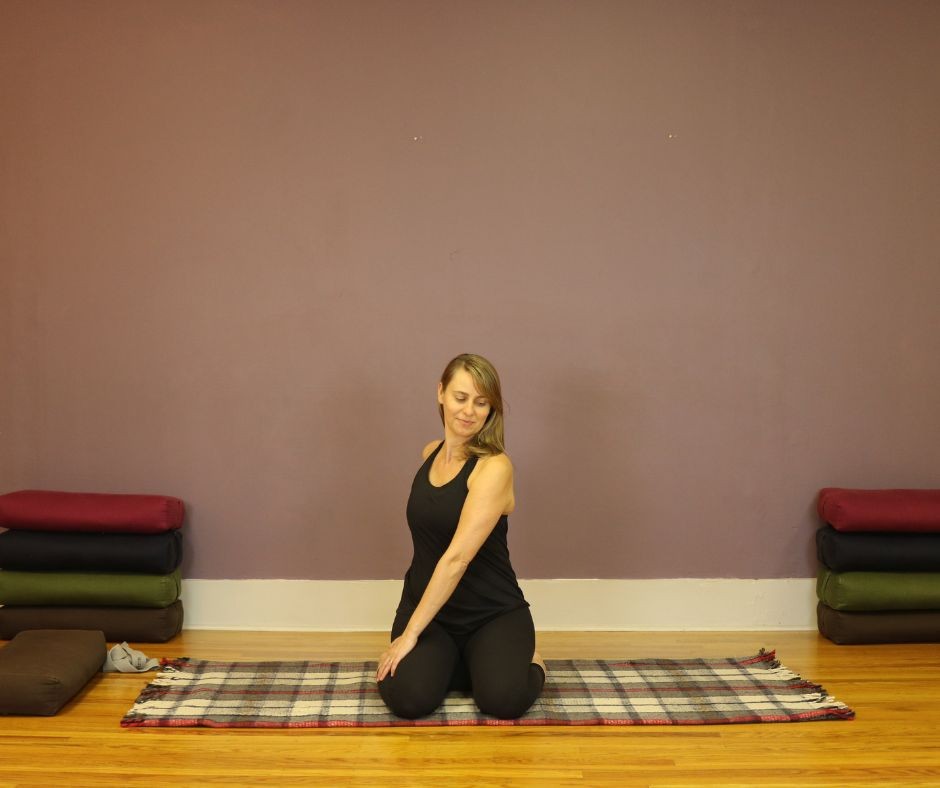
For a dragonfly with a twist, twist your spine to one side. From there, you can either stay upright or fold over the extended leg.
As an alternative to the yin yoga dragonfly pose, you can lie on your back with your legs up the wall, spread wide. This is an especially helpful variation for students who have lower back concerns.
Hold the poses for 2-5 minutes or as long as is comfortable. Place your attention on the breath and aim to be present with the sensations in the body. As you come up, slowly walk your hands in towards your body and lean back on your hands.
Depending on your sequence and needs, you could do a “windshield wiper” movement with your legs as a counterpose.