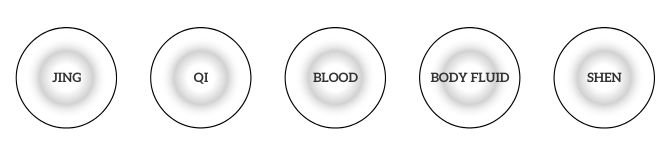
In Chinese Medicine, the body and mind function through the interaction of the “vital substances.” The vital substances are Qi, Blood (Xue), Essence (Jing), Spirit (Shen), and Body Fluids (Jin Ye). These substances are defined not so much by their location as by their function (similar to the TCM organs). (We explore the vital substances in much more detail in my course TCM for Yoga Online.)
What is Qi and why is Qi so important?
Qi is essentially potential energy that exists in everything—material and immaterial. In the body, it’s considered a very active force—it’s the energy that drives all kinds of changes and processes. It’s sometimes described as “vital energy” or “life force.” However, it’s difficult to translate perfectly because Qi can assume many forms and expressions throughout the body. For example, organ Qi, defensive Qi, nutritive Qi, meridian Qi, and ancestral Qi exist.
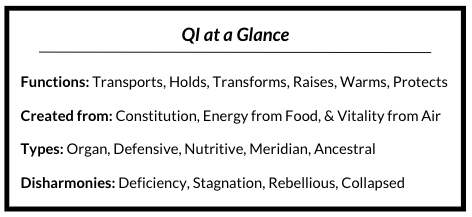
In Chinese Medicine, the state of your Qi is seen as very important for overall health. Qi also directly affects other vital substances (such as blood, yin, and yang), so there are many ways a deficiency in Qi can affect overall functioning. When Qi is deficient in the body, symptoms may include fatigue, poor digestion, coldness, paleness, spontaneous sweating, a slow metabolism, a weak immune system, and more.
In my clinical practice, it’s pretty common to see folks who are Qi deficient. Whether it’s overwork, improper or poorly digested food, aging, childbirth, or simply insufficient sleep, there are many reasons why patients end up Qi-deficient and can benefit from building their Qi.
Even if you don’t have any intense symptoms of Qi deficiency, you can still use Qi tonics to boost energy, leading to longevity, strong immunity, good digestion and assimilation, and prevention or reversal of the signs of aging. In this way, Qi tonics in Chinese Medicine are similar to rasayanas in Ayurvedic medicine. Both aim to support the body’s overall functioning and are wonderful remedies to have on hand. Many Qi tonics can be used as medicinal foods.
How to make qi boosting medicinal congees (porridge)
One way to incorporate Qi tonics into your food is through medicinal congee (kanji), a grain porridge. These are often served at breakfast and are revered in Chinese Medicine for their ability to support digestion and provide deep nutrition. Anyone looking to support digestive function and build Qi and Blood can use them. They are also commonly used during chronic illness, weakness, fatigue, and poor appetite.
Congee can be made with almost any grain and cooked for an extended period in ample water. It is often supplemented with proteins, vegetables, spices, and medicinal herbs. This results in a well-cooked, easy-to-digest meal that does not cause dampness.
TO MAKE CONGEE: Generally, 1 cup of grain is brought to a boil and then simmered with 5-10 cups of water for 1-8 hours (on the stovetop or with a slow cooker). The exact proportions depend on how watery you want the final product to be. The thinner the porridge, the more digestible. (We cover how and why to make congees in more detail in my course TCM Food Therapy Online.)
DIRECTIONS for QI TONIC CONGEE/PORRIDGE:
- Choose 2-4 herbs from the list below. Place a small handful of each herb in about 1L of water.
- Bring to a boil, then cover and simmer for 10-20 minutes until the water is reduced to about half.
- Strain the herbs and keep the liquid tea. A portion can be saved in the refrigerator for future use.
- Use the tea (the amount depends on how much congee you’re making) as the liquid for your porridge.
- Add grain, berries, nuts, and any other additions to the tea liquid. I recommend adding ginger or cinnamon, as some herbs have stronger flavours. Cook until the grain is ready and the desired consistency is met.
Qi Tonic Herbs
The single herbs below are all excellent places to start when making medicinal soups or congees. You can add the herbs directly to the grain while cooking or make a decoction with the herb (as described above) and add just the tea to the grain during cooking.
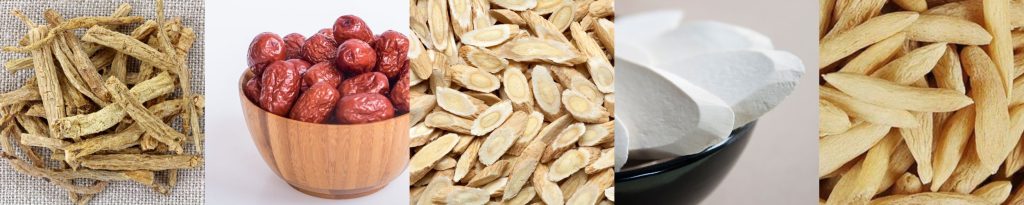
DANG SHEN – Codonopsis Root (Codonopsis Radix) – builds Qi and Blood and especially acts on the Lungs and Spleen Qi (digestive function). It has a mild sweet taste and a neutral thermal nature, so it won’t be too heating or cooling.
DA ZAO – Chinese Date (Jujube Fructus) – tonifies Qi and blood and especially supports Spleen Qi and the digestive system. Very sweet and warm, and often used in medicinal food recipes. It also calms the spirit.
HUANG QI – Astragalus (Astragali Radix) – builds Qi and Yang, restores Spleen and Lung Qi if there is fatigue, loose stools, and lack of appetite. Also supports immunity and reduces edema.
SHAN YAO – Chinese Yam (Dioscoreae Rhizoma) – harmonizes and moderates. It tonifies Qi and yin and acts on the Kidneys, Lungs and Spleen. It is neutral and sweet, working gently and slowly over time to build strength.
MAI MEN DONG – Ophiopogon Tuber (Ophiopogonia Radix) – moistens, nourishes yin and is slightly cold, making it helpful if there is heat, dryness, burnout, and/or inflammation. It especially acts on the Stomach, Spleen, Heart, and Lungs. This herb can act to balance more heating herbs in a formula or combination.
**These herbs are generally very safe for the general population, but as always, if any of them don’t agree with you, stop taking them and check with your practitioner.
I hope you enjoy your Qi tonics! If you’d like to learn more about Chinese Medicine and using Chinese Medicine principles in your cooking, you may enjoy my course Chinese Medicine Food Therapy.