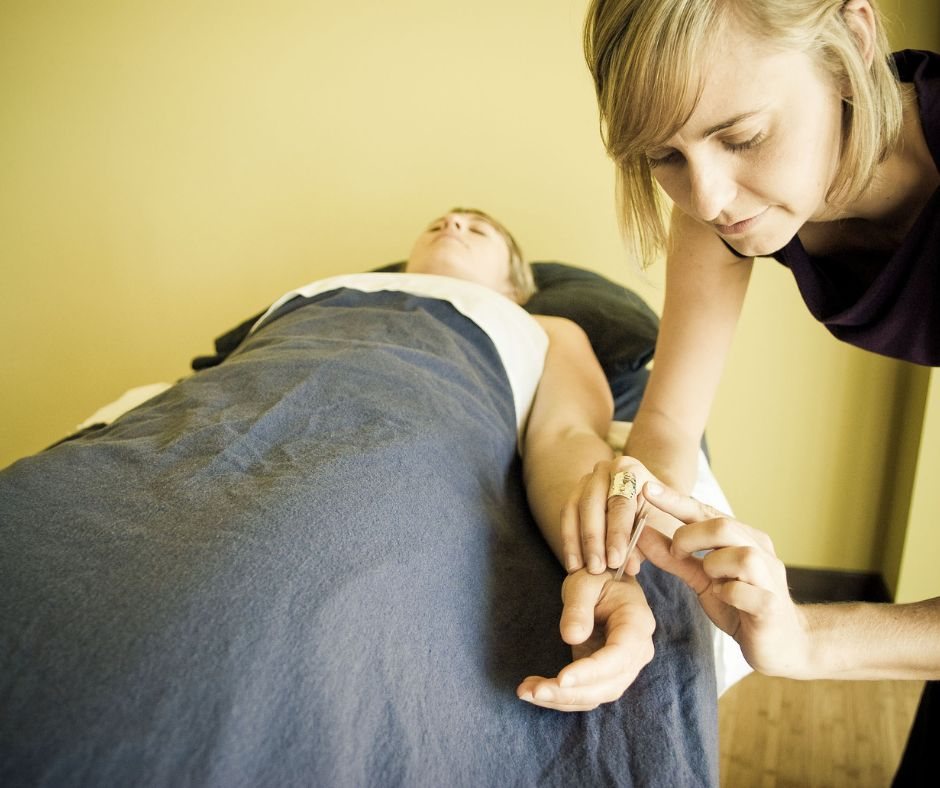
Acupuncture is one of the modalities used within the broader umbrella of Traditional Chinese Medicine. An acupuncturist uses the placement of very thin pins at specific acupuncture points on the body to elicit a healing response.
Watch the video and read the post below to learn more!
What is acupuncture and how does acupuncture work?
Acupuncture involves working with the body’s Qi. Qi is considered the basic life force that runs through absolutely everything, including our bodies. Qi travels along the body’s channels, or meridians. These channels are related to internal organs, certain emotional states, bodily tissues and/or fluids. Sometimes the Qi in these channels becomes stagnant or deficient. When this happens, the Qi cannot nourish the body or promote healing.
Western medical science is finding more and more ways to explain the effectiveness of this ancient system of healing. Acupuncture can relax muscle groups, soothe the nervous system, and target the immune system. Some theories say meridians are housed in the connective tissues, the lymphatic system, and/or the electromagnetic field that the human body radiates.
It can be interesting to use Western anatomical and scientific terms to describe acupuncture. But personally, I found it helpful to stick to explanations using the language of Chinese Medicine. The understanding and description of acupuncture in Chinese Medicine terminology are much more nuanced and complex than in our Western language.
The needles we use in acupuncture are very thin, sterile, and flexible. This is in contrast to much thicker blood-collection needles. Needles that draw blood tear tissue, whereas acupuncture needles push tissue away.
When receiving acupuncture, you may feel a slight prick, but most people feel only a dull pressure. Acupuncture is not nearly as painful as a needle that draws blood. In fact, it can be pretty interesting to notice the sensation of Qi when the acupuncture needles activate it.
Acupuncture treats the whole person; a practitioner will start with a comprehensive intake process that could include assessing a person’s body type, listening to their pulse, and taking an inventory of their energy levels, sleep, and digestion. From there, the practitioner will base their diagnosis, point selection, and treatment on the whole picture.
If you haven’t tried acupuncture, I highly recommend it!