"There is one thing monks, that cultivated and regularly practiced, leads to a deep sense of urgency... the supreme peace... to mindfulness and clear comprehension... to the attainment of right vision and knowledge... to happiness here and now,..... to realizing deliverance by wisdom and the fruition of holiness: it is mindfulness of the body."
The Buddha
Through a yoga or meditation practice we learn to be with ourselves in order to deeply experience ourselves. We commit to arriving here and now with wholehearted presence and we become familiar with our home base. This takes love, courage, honesty, and gentleness.
We come home to ourselves by quieting the body, mind, and breath and by paying attention. From this place of relative stillness our true nature shines through.
The practice of mindfulness helps us to experience increasing presence in our lives. Instead of abandoning ourselves when we encounter difficulty, we are fully awake. Mindfulness also strengthens and re-programs the nervous system, so that we experience a lesser degree of struggle during physical, mental, or emotional challenge. We train the mind to reduce resistance and contraction when events don’t go according to plan.
Mindfulness is the practice of directing your mind by cultivating the power of your attention. In other words, we are working and strengthening the muscle of awareness through sustaining a focus. Through this training we actually condition the mind to be more mindful.
The practice of mindfulness begins with concentration. We collect, direct, and maintain our attention so that it becomes unified. We do this by noticing our present state.
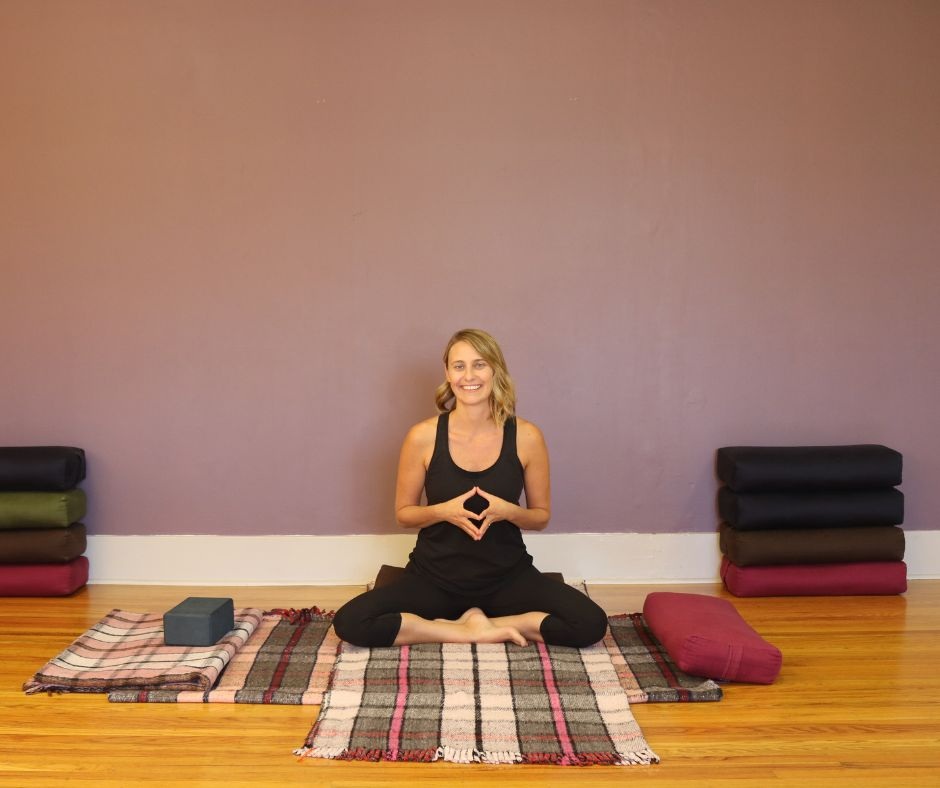
Begin by finding a comfortable sitting position. You can sit on a cushion, cross legged, or on a bench or chair. Most importantly find a place where it’s possible to relax and maintain the focus of your attention. Find suggestions for meditating without pain here.
Notice the breath in the whole body. Observe the rise and fall of your chest and belly and the expansion and contraction of every exhale and inhale.
Once you have established a stable place of arrival, use this classic acronym to direct your attentive awareness.
R - Recognize
As you open to bare attention notice what arises. Perhaps there are sounds, feelings, sensations in the body, or thoughts in the mind.
As these various phenomenon pass through take the opportunity to pause, soften, and ask yourself what is happening right now? Keep your undivided attention on your moment – to – moment experience. Be aware.
A- Allow
There is a space between the experience itself and the reaction to the experience. Notice this gap.
The general tendency is to move away from experiences we judge as negative, to grasp experiences we judge as positive, and to ‘zone out’ during experiences that are neutral. All of these responses lead to suffering because you lose the opportunity to experience the richness and truth of the present moment. Simply noticing these tendencies weakens them.
"Let yourself be open and life will be easier. A spoon of salt in a glass of water makes the water undrinkable. A spoon of salt in a lake is almost unnoticed."
The Buddha
I - Investigate
As you recognize what is happening and give it space, you may start to notice how you are relating to your experience. Where are you caught?
This is not a cognitive exercise. Aim to keep your attention on your lived, present – moment experience. Notice the rising and falling of phenomenon without getting attached to story or identification with any one thought, sensation, or feeling.
As you develop mindful attention you are learning to look around and see where you’re holding on and where you’re pushing away. Practice helps you face what is in you that wants to separate, defend, or aggress. Begin to see the inherent suffering in always wanting things to be a little different than they are.
Perhaps you begin to notice the way the mind replays thoughts, or the way you label some experiences as “bad” or “good”. Or maybe you start to notice that nothing ever remains the same. Even physical sensations that at first feel solid and fixed, when investigated, are ever changing and transient in nature.
N - Non-Identification
"Moment by moment things are losing their hardness; even my body now lets the light through"
Virginia Woolf
The process of non-identification is a gradual process. Letting go and resting in allowance of what is without an agenda for change is not always easy. But, as you use mindfulness and see how your gripping and resisting causes suffering, a natural letting go happens.
Meditation is about cultivating the open kind space that honors the truth of the moment, however painful or blissful, without making the moment “me and mine”.
As you start to see every moment as a collection of experiences, whether they are pleasant, unpleasant, sensation, feeling, or thought, you can loosen your grip on life and allow it to flow without so much identification to a personal “self”.
Who and what remains when you release your identification with the self that has preference and is identified with pain and pleasure?
The natural mind is radiant, pure, and un-conflicted. The practice of mindfulness helps us to experience this for ourselves. I encourage you to use your own practice to experiment and see what you find.
Learn more about mindfulness practice in my Mindful Yin Yoga Online Training